- EN
-

Choosing hydroponic farming equipment for an indoor commercial farm requires a system-level approach. The right setup should match the crop, production target, available floor area, planting density, irrigation method, lighting requirements, environmental control needs, and future expansion plan. Instead of selecting equipment only by price, commercial growers should evaluate how each component contributes to stable and efficient year-round production.
A complete indoor farm may combine growing channels or trays, multi-tier racks, nutrient circulation, pumps, reservoirs, artificial lighting, environmental control, sensors, and automation. When comparing hydroponics farming equipment, buyers should therefore focus on how well these components work together within a controlled indoor growing environment.
The exact equipment configuration varies according to the crops being grown, but most commercial indoor hydroponic projects require several core systems:
Growing channels, trays, racks, or planting modules
Nutrient solution reservoirs
Pumps and water circulation equipment
Irrigation and drainage systems
Artificial grow lighting
Temperature and humidity management
Ventilation and air circulation
Nutrient concentration and pH monitoring
Timers, sensors, and automated control equipment
The first step is not deciding which machine to purchase. It is defining what the farm needs to produce.
A leafy vegetable facility may prioritize high planting density and fast crop turnover, while a seedling operation may require flexible trays and precise irrigation cycles. An indoor container farm may place greater emphasis on compact multi-tier layouts, climate control, lighting efficiency, and automation.
Different crops require different root environments and growing structures. Selecting the right hydroponic system is therefore one of the most important decisions when planning an indoor farm.
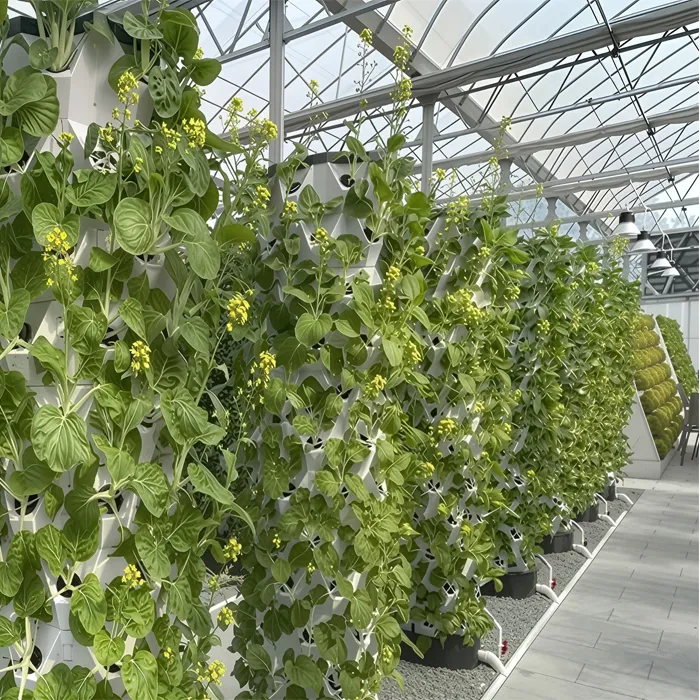
Nutrient Film Technique, or NFT, continuously circulates a shallow layer of nutrient solution through planting channels. This allows roots to receive water and nutrients while maintaining access to oxygen.
An indoor nft hydroponic system can be especially useful for commercial leafy vegetable production because NFT channels can be arranged in horizontal, A-frame, or vertical structures to make better use of indoor space.
HydroBlue's HN2 A-Frame Planting Trough, for example, uses a multi-layer A-shaped structure with customizable layer counts and adjustable inclination. According to HydroBlue's published specifications, its planting density can be 30%–50% higher than a flat trough arrangement.
This type of configuration can be considered when an indoor farm needs to increase growing capacity without proportionally increasing its floor footprint.
Ebb and flow cultivation works differently. Nutrient solution periodically floods the growing tray before draining back into the reservoir, creating alternating irrigation and aeration cycles around the root zone.
An ebb and flow tray can be useful for indoor seedling production and other tray-based cultivation applications.
HydroBlue's HT1 Flat Tray Ebb and Flow system uses a wide waterproof tray with timer-controlled flood-and-drain cycles. Its published specifications include an ABS plastic panel, hot-dip galvanized or thickened aluminum alloy support material, and an adjustable or customizable height of 0.7 m.
For growers, the key question is not whether NFT or ebb and flow is universally better. The right choice depends on crop characteristics, planting format, root-zone requirements, production workflow, and the level of flexibility needed.
Floor space is a major cost factor in commercial indoor farming. For this reason, equipment should be evaluated not only by the number of plants it can hold, but also by how efficiently it uses the available volume of the facility.
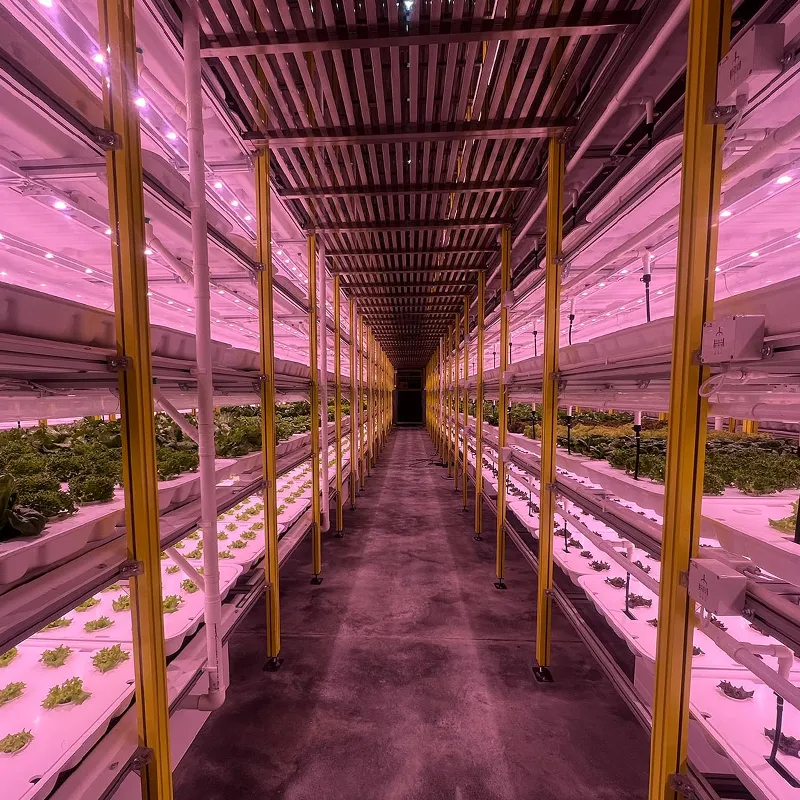
Single-layer systems provide straightforward access for planting, monitoring, cleaning, and harvesting. However, when floor space is limited, multi-tier systems can expand cultivation vertically.
HydroBlue's HT2 Multi-Tiered Ebb and Flow system is designed around this principle. The system uses a multi-layer rack structure, with independent control available for irrigation and lighting on each layer. Its frame is made from high-strength steel or corrosion-resistant metal, while tray size can be customized.
When assessing a multi-tier indoor system, buyers should consider:
Number of usable growing layers
Distance between layers
Crop mature height
Lighting installation
Airflow between racks
Worker access
Irrigation and drainage layout
Harvesting and maintenance procedures
Adding more layers does not automatically create a better farm. The objective should be to increase productive growing area while maintaining uniform crop conditions and practical daily operation.
The following examples are based on specifications currently published on HydroBlue's official product pages.
| HydroBlue System | Published Specification | Indoor Application Consideration |
|---|---|---|
| HN2 A-Frame Planting Trough | PVC-U material; customizable multi-layer design; adjustable inclination; planting density 30%–50% higher than flat troughs | High-density leafy vegetable production |
| HT1 Flat Tray Ebb and Flow | ABS plastic panel; galvanized or thickened aluminum alloy bracket; 0.7 m adjustable/customizable height; timer-controlled flood-drain cycle | Seedlings and tray-based cultivation |
| HT2 Multi-Tiered Ebb and Flow | Multi-layer rack; independent irrigation/lighting control; high-strength steel or anti-corrosion metal; customizable tray size | Vertical indoor seedling and high-density production |
Commercial buyers should use this type of specification comparison as a starting point rather than choosing equipment from product appearance alone.
Material durability, adjustability, irrigation control, crop compatibility, cleaning requirements, and expansion potential all affect the long-term operating value of an indoor farming system.
Artificial lighting is one of the core systems in an indoor farm because crops cannot depend on natural outdoor conditions.
Lighting should therefore be designed together with the growing racks rather than added after the cultivation system has already been selected.
Important factors include:
Crop light requirements
Distance between lights and plant canopy
Number of rack layers
Light uniformity
Heat generated by fixtures
Photoperiod
Electricity consumption
Ability to adjust lighting as plants grow
In a multi-tier facility, each layer must receive sufficiently uniform light. Poor fixture placement can create uneven crop development even when irrigation and nutrient management are functioning correctly.
Buyers should consequently evaluate the complete rack-and-light arrangement when calculating potential planting capacity.
A commercial hydroponic farm depends on consistent delivery of water, dissolved nutrients, and oxygen to the roots.
The nutrient management system may include reservoirs, pumps, piping, filters, dosing equipment, circulation systems, and sensors for monitoring important solution conditions.
Automation becomes increasingly valuable as production scale grows. A small system may be manageable with basic timers, while a larger indoor facility may require centralized monitoring and more precise control.
When evaluating equipment, commercial growers should ask:
Can irrigation frequency be adjusted?
Can different growing zones operate independently?
Is the system easy to drain and clean?
Can pumps and filters be accessed for maintenance?
Can nutrient conditions be monitored consistently?
Can additional planting areas be connected in the future?
These operational questions often have a greater long-term impact than the initial equipment price.
Hydroponics removes soil from the growing process, but it does not remove the need to manage the growing environment.
Indoor commercial farms need to maintain suitable conditions for temperature, humidity, airflow, and lighting. Depending on the crop and facility, growers may also monitor carbon dioxide levels and other environmental variables.
Environmental control should be planned according to both the crop and the equipment layout. Closely spaced multi-tier racks, for example, require careful air circulation to minimize differences between upper and lower growing levels.
A well-designed indoor system should make environmental conditions measurable and controllable instead of leaving crop performance dependent on uncontrolled fluctuations.
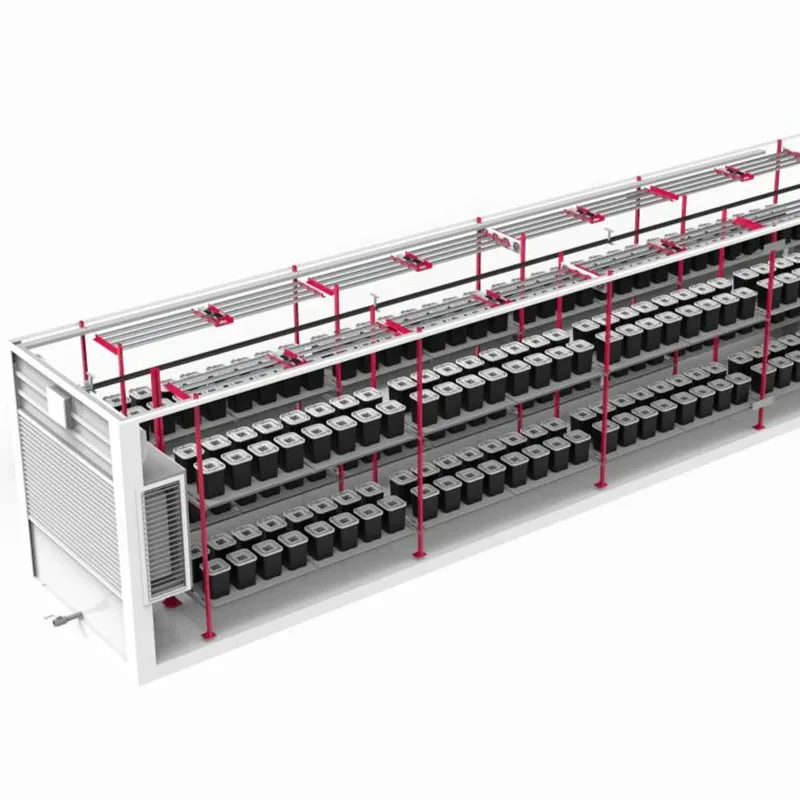
Some commercial growers require a more standardized and modular production environment. In this case, a hydroponic container for sale may provide an alternative to building a larger indoor plant factory from the ground up.
HydroBlue offers hydroponic grow containers developed for different crops, including strawberries, fruiting vegetables, leafy vegetables, mushrooms, and forage grass. Its grow-container range is designed around crop-specific internal layouts rather than using one identical growing structure for every plant type.
Container systems can be considered when buyers need:
A modular production unit
Controlled indoor cultivation
Compact installation
Standardized internal layouts
Easier replication across multiple locations
Expansion by adding additional units
However, buyers should still calculate lighting, cooling, ventilation, nutrient circulation, labor access, and electricity requirements before determining the number of units required.
An indoor hydroponic project should be designed not only for its initial production capacity but also for future growth.
A modular system allows farms to add racks, growing channels, trays, containers, or cultivation zones as demand increases. This can reduce the need for a complete redesign during expansion.
Before purchasing equipment, ask the supplier whether:
Growing modules can be expanded
Rack dimensions can be customized
Irrigation zones can operate independently
Lighting can be adjusted or upgraded
Replacement components are readily available
Equipment can accommodate additional production capacity
Scalability is especially important for commercial farms testing a new crop or market before moving to full-scale production.
The more detailed the project requirements, the more accurately a supplier can recommend an indoor hydroponic configuration.
Before requesting a proposal, buyers should prepare information such as:
Crop type and variety
Target daily or annual output
Indoor facility dimensions
Available ceiling height
Planned number of growing layers
Local electricity conditions
Water quality
Required automation level
Available labor
Desired expansion capacity
Rather than purchasing isolated components, commercial buyers should request a solution that connects cultivation, irrigation, lighting, environmental control, and farm operation into one coordinated system.
A typical indoor commercial farm requires growing channels or trays, racks, nutrient reservoirs, pumps, irrigation and drainage equipment, artificial lighting, ventilation, environmental control, sensors, and monitoring or automation systems. The exact configuration depends on crop type and production scale.
Yes. NFT is particularly suitable for many leafy vegetables and herbs. Horizontal, A-frame, and vertical configurations can be selected according to available indoor space and required planting density.
Multi-tier systems can significantly improve space utilization, but they also require careful lighting, ventilation, irrigation, and worker-access planning. The number of layers should therefore be determined by crop requirements rather than maximizing rack height alone.
NFT provides a continuous shallow flow of nutrient solution through growing channels. Ebb and flow systems periodically flood and drain the root zone. NFT is commonly used for leafy crops, while ebb and flow configurations can be useful for seedlings and tray-based cultivation.
Buyers should compare crop compatibility, planting density, materials, irrigation method, automation, lighting compatibility, maintenance requirements, expandability, and total operating requirements instead of comparing only purchase prices.
Choosing hydroponic farming equipment for an indoor commercial farm begins with clearly defining the crop, production target, available space, planting density, and operating requirements. NFT channels, ebb and flow trays, multi-tier racks, nutrient management systems, artificial lighting, environmental control, and containerized solutions can each play different roles within an indoor production facility.
The best equipment configuration is one that creates a stable, manageable, and scalable growing environment while supporting the farm's long-term production goals.