- EN
-

Choosing the right NFT hydroponic system requires more than comparing channel sizes or equipment prices. Commercial growers need to consider crop type, planting density, available space, nutrient circulation, lighting arrangement, daily maintenance, labor efficiency, and future expansion before deciding on a suitable configuration.
A well-designed commercial NFT hydroponic system should help growers maintain consistent nutrient delivery, make efficient use of cultivation space, and support stable production over repeated growing cycles. The right system should also be easy to clean, manage, and expand as production requirements change.
NFT stands for Nutrient Film Technique. In this system, a shallow stream of nutrient solution continuously flows through slightly inclined growing channels.
Plant roots extend into the channels and absorb water and dissolved nutrients from the circulating solution. Because the channels are not filled, part of the root zone remains exposed to air, helping provide oxygen to the roots.
A typical NFT system usually includes:
Growing channels or planting troughs
Planting holes and net pots
Nutrient solution reservoir
Water pump
Supply and return pipes
Flow-control components
Lighting equipment
Timers or controllers
Monitoring equipment
The basic working principle is simple, but system configuration becomes increasingly important as the farm scales up.
NFT is commonly used for crops with relatively compact root systems and shorter growing cycles.
Typical crops include:
Lettuce
Leafy greens
Basil
Spinach
Pak choi
Kale
Mint and other herbs
These crops can usually be planted at relatively consistent spacing and respond well to continuous nutrient circulation.
Before selecting a system, growers should first identify the crop variety, mature plant size, root characteristics, desired planting density, and expected harvest cycle. These factors directly affect channel spacing, system dimensions, and overall layout.
Flat NFT systems arrange growing channels horizontally on a support structure. This layout is straightforward and usually provides convenient access for transplanting, inspection, cleaning, and harvesting.
A horizontal NFT system can be suitable for projects where ease of operation and maintenance are important.
HydroBlue's HN1 Flat Planting Trough uses PVC-U channels and a horizontal planting structure. According to the published product information, the system supports customizable trough dimensions and planting-hole spacing of approximately 150–200 mm.
The flat arrangement can offer several operational advantages:
Easy access to plants
Convenient channel inspection
Straightforward cleaning
Simple harvesting workflow
Easier observation of root development
The main consideration is space utilization. A single-layer system generally requires more floor area to achieve the same planting quantity as a multi-level configuration.
When growers need to increase production capacity within a limited footprint, an A-frame system can be an effective alternative.
With a frame hydroponics, channels are positioned on both sides of an A-shaped structure. This allows multiple growing levels to occupy the same basic floor area.
HydroBlue's HN2 A-Frame Planting Trough uses PVC-U channels with a customizable multi-layer structure. The inclination can be adjusted to help maintain nutrient flow through the channels.
According to HydroBlue's published information, the HN2 configuration can provide approximately 30%–50% higher planting density than a flat trough arrangement.
This type of system may be suitable when growers need:
Higher plant quantity per square meter
Efficient use of available growing space
Multiple planting levels
Flexible layer configuration
Better use of vertical capacity
However, greater planting density should not come at the expense of light distribution, airflow, worker access, or plant spacing.
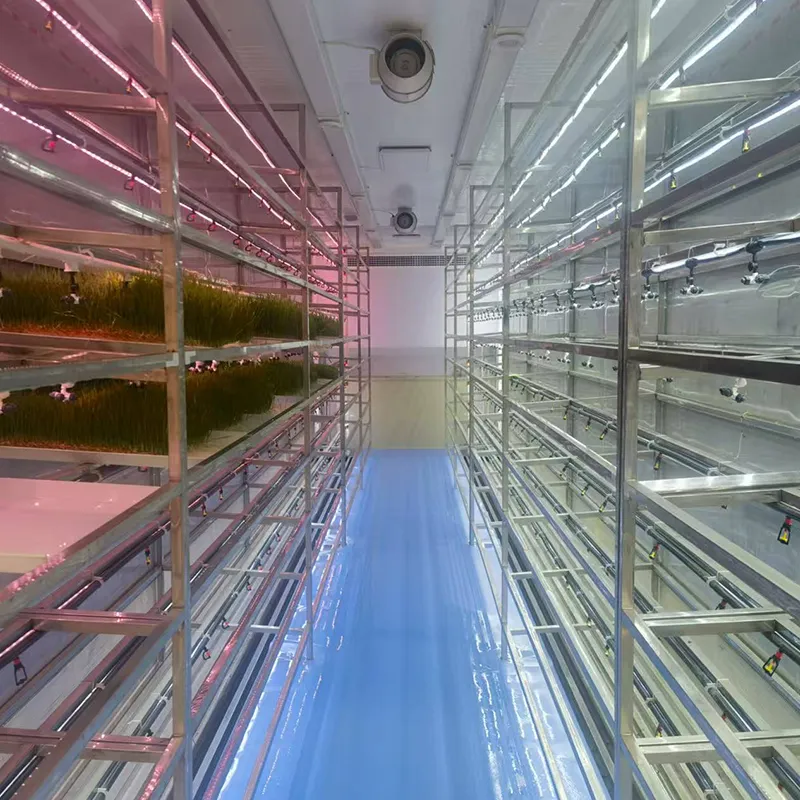
A vertical NFT system uses a tiered structure to increase planting capacity by extending cultivation upward.
This configuration can be useful for farms that want to increase production without proportionally increasing the floor footprint.
When evaluating a vertical system, buyers should consider:
Number of planting levels
Distance between levels
Crop mature height
Light distribution
Air circulation
Nutrient flow
Worker access
Harvesting efficiency
Cleaning requirements
More levels do not automatically result in better commercial performance. If plants receive uneven light or airflow, higher theoretical planting density may reduce crop consistency.
The objective should therefore be to balance planting capacity with manageable daily operation.
The following comparison is based on information currently published for HydroBlue's NFT product range.
| NFT Configuration | Published Features | Suitable Consideration |
|---|---|---|
| HN1 Flat Planting Trough | PVC-U material; customizable trough dimensions; planting-hole spacing approximately 150–200 mm | Projects prioritizing simple access and straightforward management |
| HN2 A-Frame Planting Trough | PVC-U material; customizable multi-layer design; adjustable inclination; 30%–50% higher planting density than flat troughs | Farms requiring higher planting density within limited space |
| HN3 Vertical Planting Trough | Vertical tiered growing configuration | Projects aiming to increase planting capacity through vertical space |
This comparison shows why equipment selection should be based on overall production requirements rather than on one specification alone.
Before choosing a system, growers should measure both the usable growing area and the space required for daily operation.
Not all available area can be occupied by planting channels. Commercial farms also need space for:
Worker aisles
Nutrient tanks
Pumps
Filtration equipment
Electrical components
Lighting structures
Packing and harvesting areas
Maintenance access
For example, reducing aisle width may allow more channels to be installed, but it can also slow planting, harvesting, and cleaning.
The most efficient layout is not necessarily the one with the highest theoretical plant count. It is the one that supports both productive cultivation and efficient farm operation.
Lighting layout should be considered at the same time as the NFT structure.
A flat system usually has a relatively uniform crop canopy, making lighting arrangement simpler. A multi-level or vertical system requires more careful fixture placement so that plants at different heights receive suitable light.
Growers should evaluate:
Fixture position
Distance between lights and plants
Light uniformity
Crop growth height
Number of planting levels
Heat generated by lighting
Power consumption
If lighting is not coordinated with the growing structure, increased planting density may not translate into consistent crop quality.
Continuous nutrient circulation is one of the defining characteristics of NFT.
The system should deliver an even nutrient film through the growing channels while allowing the solution to return efficiently to the reservoir.
Important design factors include:
Channel inclination
Pump capacity
Pipe dimensions
Flow rate
Reservoir volume
Return-water design
Pump reliability is also important because interruptions in nutrient flow can affect plants quickly.
For commercial projects, growers may consider backup pumps, monitoring systems, alarms, or other measures that reduce the risk of prolonged circulation failure.
NFT systems need regular cleaning to maintain reliable nutrient circulation.
Growing channels, reservoirs, pumps, pipes, and filters should all be accessible for inspection and maintenance.
Before purchasing equipment, buyers should check whether:
Channels are easy to access
Reservoirs can be drained conveniently
Pumps can be removed or serviced
Pipes can be inspected
Individual sections can be cleaned
Components can be replaced without major disassembly
A system that is easier to maintain can help reduce downtime and labor requirements over repeated crop cycles.
Commercial farms may begin with one production zone and expand after market demand increases.
For this reason, scalability should be considered before equipment is purchased.
A modular NFT system can make it easier to add:
Additional planting channels
More growing racks
Extra nutrient circulation zones
Additional lighting
New production areas
Growers should ask whether the system can be expanded without replacing major components or redesigning the entire farm.
Before requesting a quotation or system proposal, buyers should prepare basic project information such as:
Crop type
Facility dimensions
Available growing area
Target plant quantity
Required planting density
Expected production cycle
Water quality
Electricity conditions
Lighting requirements
Automation requirements
Available labor
Future expansion plans
Providing detailed project information helps the supplier recommend a system based on actual production needs rather than offering a standard configuration.
Yes. NFT is widely used for commercial production of leafy vegetables and herbs. Flat, A-frame, and vertical configurations allow growers to select a layout according to planting density, available space, and operational requirements.
A flat NFT system places channels on a single horizontal level and generally provides easier access. An A-frame system places channels on several inclined levels, allowing more plants to be grown within the same basic footprint.
Flat, A-frame, and vertical systems can all be suitable for lettuce. The best choice depends on production scale, desired planting density, available space, lighting layout, and labor requirements.
There is no fixed requirement. Space depends on channel arrangement, crop spacing, aisle width, nutrient reservoir placement, lighting setup, and production targets.
Buyers should evaluate channel material, planting spacing, system structure, nutrient-flow design, accessibility, maintenance requirements, lighting compatibility, scalability, and the supplier's customization capabilities.
Choosing the right NFT hydroponic system requires balancing crop requirements, planting density, available space, nutrient circulation, lighting, maintenance, and operational efficiency. Flat systems provide simple management, while A-frame and vertical configurations can help growers increase planting capacity within the available production area.
A well-planned NFT system should support stable crop production while remaining practical to operate, maintain, and expand as commercial needs develop.