- EN
-

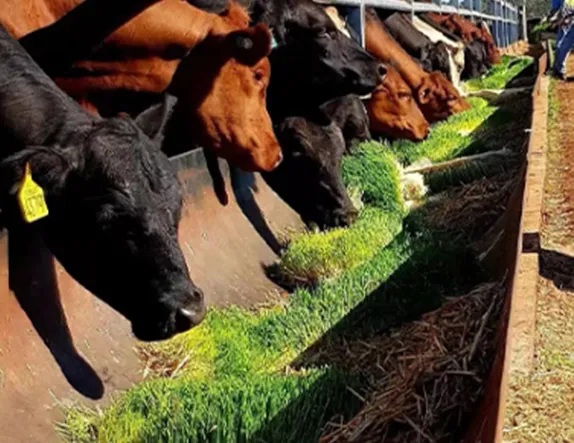
A hydroponic fodder system provides livestock producers with a controlled way to grow fresh forage such as barley grass without relying on conventional soil-based cultivation. For commercial operations, however, choosing the right system requires more than comparing equipment prices. Production capacity, livestock demand, growing cycle, water and nutrient management, environmental control, labor requirements, hygiene, and future expansion should all be considered before investment.
A properly configured hydroponic fodder system for sale can integrate planting racks, forage trays, irrigation, lighting, climate control, monitoring, and automation into one coordinated production unit. The objective is to create a stable growing process that can consistently supply fresh feed according to the livestock operation's daily requirements.
A hydroponic fodder system grows forage crops without soil by supplying seeds with controlled water, moisture, temperature, light, and airflow.
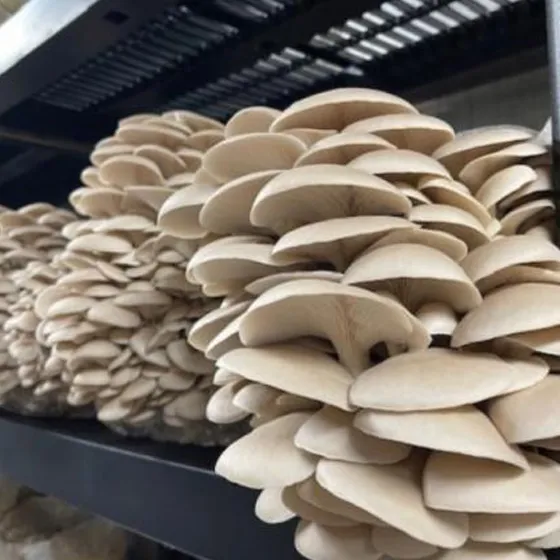
Barley is one of the most commonly used crops for this type of production. After germination, the seeds develop into a dense mat consisting of shoots, roots, and remaining grain.
HydroBlue states that its HG5 Forage Grass Grow Container is designed around a controlled production cycle that can produce forage grass in approximately 6–8 days.
A commercial system typically includes:
Seed or forage trays
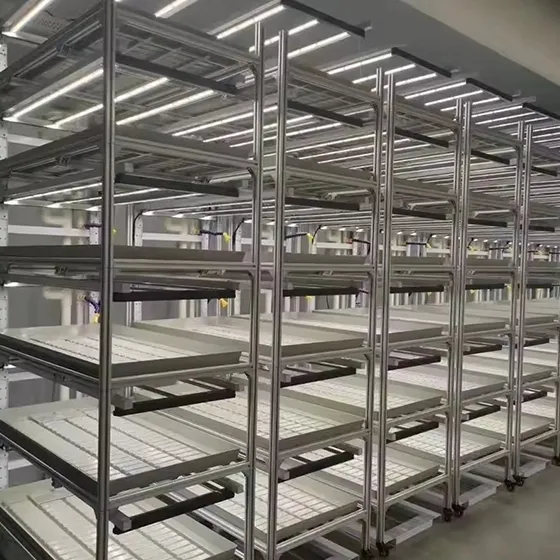
Multi-layer growing racks
Water storage
Pumps and irrigation lines
Atomizing or spraying components
LED grow lighting
Temperature and humidity monitoring
Air circulation
Environmental control
Automated management equipment
These components need to operate together because inconsistent moisture, temperature, ventilation, or irrigation can affect germination and crop uniformity.
Containerized systems package the major growing functions inside a standardized cultivation unit.
A hydroponic container for sale can provide a defined growing environment in which planting racks, irrigation, lighting, monitoring, and environmental control are planned as one system.
For livestock operations, this modular approach may offer several practical advantages:
Predictable production space
High-density rack arrangement
Centralized environmental management
Standardized production workflow
Easier replication when capacity increases
Reduced dependence on large cultivation areas
HydroBlue's HG5 system uses a standard 40-foot refrigerated thermal-insulation container as its main structure. The container incorporates a high-density polyurethane insulation layer intended to reduce heat transfer and support stable internal conditions.
The first purchasing question should be: How much fresh fodder does the livestock operation actually need each day?
A commercial buyer should calculate demand based on:
Number of animals
Livestock type
Existing feed program
Target fodder supplementation ratio
Daily consumption requirement
Growing cycle
Expected production losses
Required reserve capacity
The equipment should then be sized backward from the required daily output.
Buying a system that is too small can create inconsistent feed supply, while installing excessive capacity can increase equipment, electricity, water, and labor costs unnecessarily.
For larger projects, modular hydroponic container farming can make expansion easier because additional production units can be added as demand increases.
Planting capacity is strongly influenced by rack design.
HydroBlue's HG5 system uses nine planting layers, with a published single-layer planting height of approximately 240 mm. The rack structure uses 304 stainless steel, and the standard configuration includes 360 specialized forage grass growing trays.
Vertical rack cultivation can make efficient use of the available internal volume, but buyers should not evaluate layer count alone.
Important factors include:
Distance between growing levels
Ease of loading trays
Ease of harvesting
Cleaning access
Water distribution
Air movement
Lighting uniformity
A higher number of trays is useful only if the system can maintain reasonably consistent growing conditions across all levels.
The following information is based on HydroBlue's currently published HG5 product specifications.
| Component | Published HG5 Specification |
|---|---|
| Main Structure | Standard 40-foot refrigerated thermal-insulation container |
| Growing Rack | 9 planting layers; approx. 240 mm single-layer planting height |
| Rack Material | 304 stainless steel |
| Planting Trays | 360 specialized forage grass growth trays |
| Grow Lighting | LED grow light strips, 6 W/m |
| Irrigation | Water storage tank + pump + main/branch piping + terminal atomizing nozzles |
| Temperature & Humidity Monitoring | TECLION sensor, temperature range -40°C to 80°C, humidity range 0–100% RH |
| CO₂ Monitoring | 0–5000 ppm measurement range |
| Control Platform | Intelligent management software |
| Main Controller | 7-inch Siemens LED screen + Siemens PLC + remote control module |
| Air Management | Fresh-air system + circulation fans |
| Environmental Control | Constant-temperature unit integrated with the smart control platform |
This type of specification table is useful because commercial buyers need to compare the complete production system rather than simply the container shell or number of trays.
Fodder seeds require controlled moisture during germination and growth.
Too little water can reduce germination, while excessive or uneven moisture may create undesirable growing conditions.
The irrigation system should therefore distribute water consistently across the growing racks.
HydroBlue's HG5 configuration includes a water storage tank, pump, main and branch pipelines, and terminal atomizing nozzles.
Before purchasing a system, buyers should ask:
How frequently can irrigation cycles be adjusted?
Is spray distribution uniform across every level?
Can individual nozzles be inspected and cleaned?
How is drainage handled?
Can the water system be accessed for maintenance?
These details directly affect the reliability of everyday operation.
Hydroponic fodder grows rapidly, so environmental stability is important throughout the production cycle.
Temperature and humidity influence germination and plant growth, while airflow helps maintain more uniform conditions across densely arranged trays.
The HG5 system includes temperature and humidity monitoring, a carbon dioxide sensor, a fresh-air handling system, circulation fans, and constant-temperature equipment. Its management platform can monitor environmental sensors and manage equipment such as lighting, humidification, fresh air, and temperature control.
For buyers evaluating different hydroponic farming equipment, this integrated-control capability can be particularly important when equipment is expected to operate continuously.
Commercial livestock operations need a fodder system that fits into daily farm workflows.
Tasks may include:
Preparing seed
Loading trays
Monitoring germination
Checking irrigation
Inspecting environmental conditions
Harvesting fodder mats
Removing used trays
Washing and sanitizing equipment
Automation can reduce the amount of manual monitoring required, but it does not eliminate daily operation and maintenance.
HydroBlue's HG5 uses an intelligent management system along with a Siemens PLC-based control cabinet and remote-control module.
Buyers should therefore evaluate both automation level and practical worker access before deciding whether a system fits their operation.
A fodder growing system handles seeds, water, roots, plant residues, and high moisture levels every day.
Cleaning should therefore be considered during equipment selection.
Commercial buyers should check whether:
Trays can be removed easily
Rack surfaces are easy to wash
Irrigation nozzles are accessible
Water tanks can be drained
Pipes can be inspected
Floors can be cleaned efficiently
Growing areas can be separated from preparation areas
HydroBlue's HG5 uses 304 stainless steel for the growing racks and includes a laboratory-specific anti-slip floor mat as part of its published configuration.
A practical cleaning workflow helps reduce downtime between production cycles and supports more consistent operation.
Purchase price is only one part of the total cost of a hydroponic fodder system.
Commercial buyers should also estimate:
Lighting electricity
Temperature control
Ventilation
Water pumps
Water consumption
Labor
Seeds
Cleaning
Maintenance
Replacement components
Local electricity prices and environmental conditions can significantly affect operating costs.
For this reason, buyers should request an equipment configuration based on their production location, expected output, and operating schedule rather than relying only on a standard equipment price.
Feed demand can change as herd size increases.
A commercial operation should therefore consider whether future production capacity can be added without rebuilding the entire system.
Containerized systems are inherently modular at the unit level. A farm can begin with one production module and add additional units when daily fodder requirements increase.
However, expansion also requires sufficient supporting infrastructure, including:
Electrical capacity
Water supply
Drainage
Material handling space
Seed storage
Harvesting area
Labor
These requirements should be considered during the initial planning stage.
Before requesting a quotation, buyers should prepare clear project information.
Useful information includes:
Livestock type
Number of animals
Daily fodder demand
Preferred forage crop
Available installation space
Water conditions
Electricity supply
Required automation level
Available labor
Desired expansion capacity
The supplier should then recommend the planting capacity, number of trays, irrigation configuration, lighting, environmental control, and automation system according to these requirements.
HydroBlue states that its HG5 forage system is designed to grow fodder in approximately 6–8 days. Actual growing performance can depend on seed type, germination quality, temperature, humidity, irrigation, and operating practices.
Barley is one of the most common choices for hydroponic fodder production. The suitability of other crops depends on seed characteristics, livestock feeding requirements, and the system configuration.
The published HG5 configuration includes 360 specialized forage grass growing trays arranged on nine-layer growing racks.
Key factors include daily feed demand, production capacity, growing cycle, number of trays, irrigation design, environmental control, automation, labor, cleaning requirements, energy consumption, and expansion plans.
Containerized production can support modular expansion by adding additional production units. Buyers should ensure that water, electricity, drainage, labor, and material-handling infrastructure can support the added capacity.
Choosing a hydroponic fodder system for commercial livestock farming begins with understanding daily feed requirements and translating them into the required production capacity. Growing racks, trays, irrigation, environmental monitoring, lighting, automation, hygiene, and labor access should all be evaluated as part of the same production system.
A well-planned fodder growing system should deliver reliable production while remaining practical to operate, clean, maintain, and expand as livestock requirements change.